
Mind Over Markets: How Behavioral Discipline Drives Investment Returns
The panic of a sudden market dip. The greed that arises during a prolonged rally. We have all been there. And it’s doing extensive long-term damage to our investment portfolios.
Countless behavioral finance studies have showcased a significant negative impact on investor returns when it comes to “emotional decision-making.” We know it clouds judgement and leads to costly mistakes. So, what is the solution?
The key is in the approach. Navigating uncertain market environments lies in adopting a disciplined, non-emotional investment strategy. Yet, this is easier said than done.
How do we avoid emotional decision-making in investing? This article will cover:
1. What we can do to avoid it?
2. Why we become emotional in our decision making?
3. How emotions can impact our long-term investments?
The Reasons Why We Invest Emotionally
The answer to the why is multifaceted. Here are the 10 primary reasons for emotional investing:
1. Cognitive Biases
Loss Aversion: People feel the pain of a loss more acutely than the pleasure of a gain, leading them to sell at the wrong time to avoid further losses.
Overconfidence: Believing they can outsmart the market, some investors make hasty decisions based on incomplete information.
Herd Behavior: The fear of missing out (FOMO) or panic during a market sell-off can lead investors to follow the crowd rather than sticking to a strategy.
2. Short-Term Focus
Many investors focus on short-term market fluctuations instead of long-term goals, causing them to react impulsively to daily news or price swings.
3. Fear and Greed
Fear: Market downturns or negative news can trigger panic-selling.
Greed: Seeing others profit during a market boom can lead to impulsive buying, often at market peaks.
4. Lack of Depth in Financial Literacy
Investors without a clear understanding of markets and investment principles are more likely to react emotionally, as they lack the knowledge to interpret market movements rationally.
5. Unrealistic Expectations
Expecting quick or guaranteed returns can lead to disappointment and rash decisions when those expectations aren’t met.
6. Media Influence
Sensational headlines and market predictions from analysts can amplify emotions, prompting investors to act on fear or optimism rather than analysis.
7. Life Circumstances
Personal financial stress, such as job loss or unexpected expenses, can make investors more risk-averse and prone to emotional decision-making.
8. Overexposure to Risk
If an investor’s portfolio is too heavily weighted in risky assets, they may become overly sensitive to volatility, reacting emotionally to market dips.
9. Behavioral Anchoring
Investors may fixate on a past price or investment performance, leading them to make decisions based on what “should” happen rather than current realities.
10. Confirmation Bias
Seeking out information that supports existing beliefs can reinforce emotional decisions, even if those beliefs are flawed.
This is where HCM Funds thrives. A diverse array of actively managed strategies built to perform across market environments through a growth-oriented methodology underpinned by proprietary tactical risk management, the HCM fund family provides a comprehensive range of active MF strategies for every type of investor.
The Impact of Emotional Investing
The negative ramifications of knee-jerk or emotional investment decisions cannot be overstated, and they tend to be cumulative. Similar to a concept like tax drag, where returns are increasingly impacted by taxes on income, dividends, and capital gains over an ongoing, long-term basis, emotional investing will likely have an amplified effect over the long-term. Here are some notable findings in recent behavioral finance studies:
- Investor Behavior and Market Returns: According to a study by Dalbar, Inc., over a 20-year period ending in 2022, the average equity investor earned about 6% per year, while the S&P 500 returned closer to 9% annually1. This gap is largely attributed to poor timing decisions influenced by fear and greed.
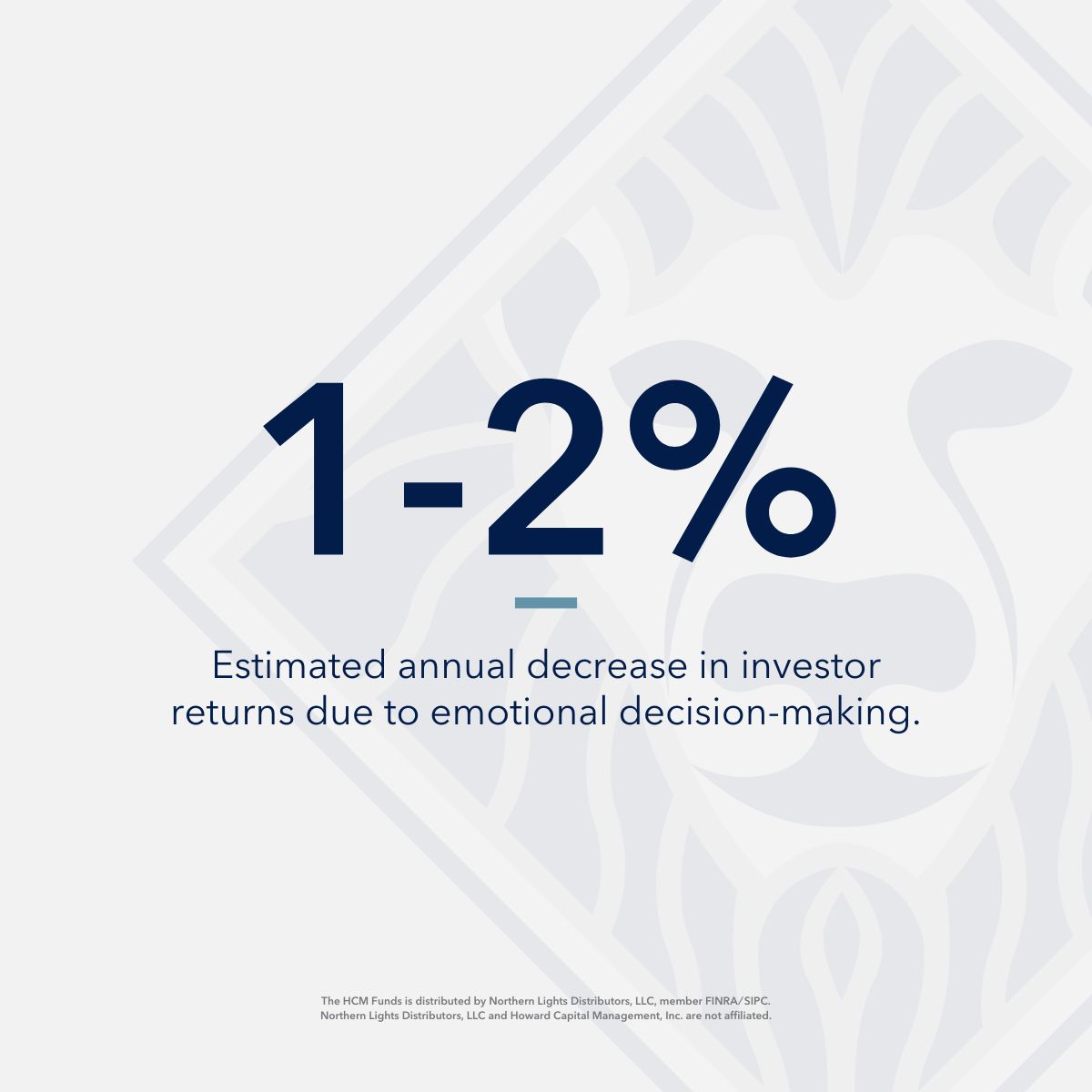
- Behavioral Penalty: Research in behavioral finance estimates that emotional decision-making can reduce investor returns by 1-2% annually, which compounds significantly over time2.
- Loss Aversion Bias: Behavioral economists Amos Tversky and Daniel Kahneman, in their prospect theory, found that the pain of losses is approximately twice as impactful as the pleasure of equivalent gains3. This bias often drives investors to sell during downturns to “stop the pain,” locking in losses.
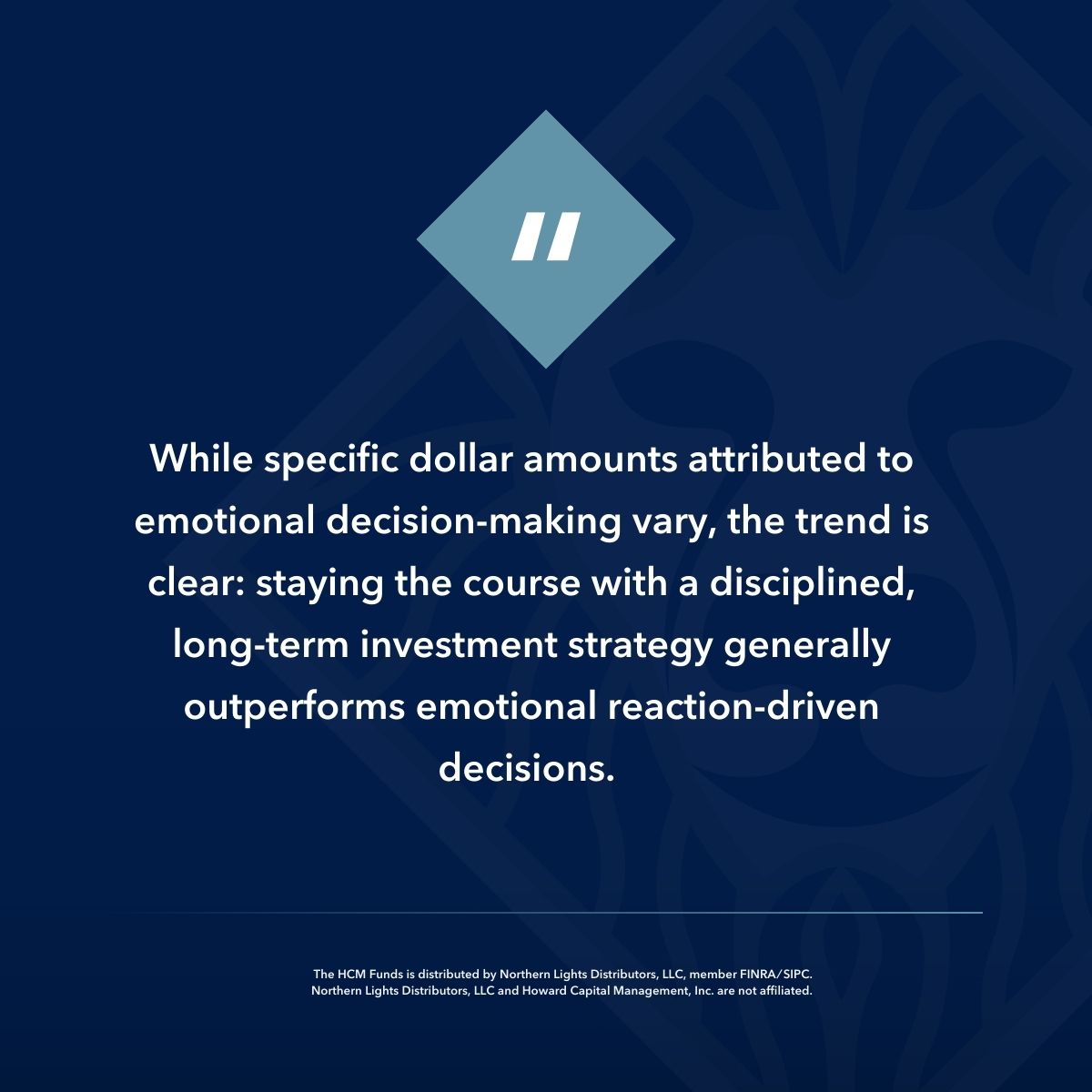
While specific dollar amounts attributed to emotional decision-making vary, the trend is clear: staying the course with a disciplined, long-term investment strategy generally outperforms emotional reaction-driven decisions.
How to Invest Without Emotion
Investing without emotion starts with creating a clear, long-term financial plan aligned with your goals, risk tolerance, and time horizon—and sticking to it regardless of market conditions. But to actually achieve alpha, you have to do more. At Howard Capital Management, we seek to take non-emotional investing one step further by integrating quantitative controls into our active management approach to deliver a truly objective process.
By using data-driven, algorithmic methodologies, the aim is to generate growth while tactically managing downside risk. This ensures decisions are guided by quantitative analysis rather than sentiment, enabling our ability to remain focused on long-term objectives, even during uncertain and volatile times.
Investment Trend Indicator Technology
One of the key elements of our in-house approach is the HCM-BuyLine®, a proprietary risk management indicator. The HCM-BuyLine® monitors market conditions in real-time, identifying imbalances that may signal potential opportunities or risks. When market conditions are unfavorable, the HCM-BuyLine® alerts us to adjust our portfolios and reduce exposure to downside risk. This proactive, disciplined approach to investing helps mitigate potential losses while allowing us to capitalize on growth opportunities when the market presents them.
Mitigating Risk with Tacticali, Active Managementii
Our trend-driven approach to investing is rooted in tactical asset allocation. Unlike passive strategies that may simply track a market index, our active, quantitative strategies are designed to adjust to changing market conditions. This flexibility allows us to move quickly in response to opportunities or risks, which can be especially important in uncertain or volatile markets.
In addition to tactical adjustments, our quantitative decision-making processiii helps minimize emotional bias and reduce emotionally driven investment decisions. By following a repeatable, data-driven methodology, we ensure our investment decisions align with the long-term goals and risk tolerance levels assigned to our funds. This approach not only aims to mitigate risk but also provides an opportunity to investors to remain steady even in turbulent times.
Staying Disciplined During Volatility
The most successful investors aren’t those with perfect market timing or exclusive information—they’re those who maintain behavioral discipline through market cycles. By understanding the psychology that drives investment decisions and implementing systematic approaches to counteract emotional biases, investors can potentially significantly improve their long-term results and experience greater confidence even during periods of extreme market volatility.
For financial advisors and individual investors, Howard Capital Management provides a proactive investment approach that combines quantitative analysis with disciplined tactical management. With tools like the HCM-BuyLine® and a focus on managing risk intelligently, we seek to help investors stay on track toward their financial goals and remain confident on the journey knowing that their strategy is rooted in data and designed for long-term results.
1https://atlasfinancialinc.com/wp-content/uploads/2023/06/DALBAR-2023-QAIB.pdf
2https://www.morningstar.com/lp/mind-the-gap
3https://www.behavioraleconomics.com/resources/mini-encyclopedia-of-be/prospect-theory/
Disclosure:
iTactical: Referring to a dynamic and flexible approach where asset allocations are adjusted in response to short-term market conditions and trends, aiming to capitalize on opportunities and potentially improve risk-adjusted returns.
iiManagement Risk: The Adviser’s reliance on its strategy and judgments about the attractiveness, value and potential appreciation of particular securities and the tactical allocation among the Fund’s investments may prove to be incorrect and may not produce the desired results.
iiiQuantitative decision-making process: Uses numerical data, mathematical models, and statistical analysis to identify and evaluate different options, leading to data-driven decisions.
The Funds’ portfolio holdings as of the end of each calendar month are posted on the Funds’ website no later than thirty days after the end of each month. This posted information generally remains accessible until the Funds post the information for the next calendar month to the Funds’ website. The Funds may choose to post their portfolio holdings on a more frequent basis,
especially during periods of high market volatility. These off-cycle disclosures will be replaced with the normal monthly release when available.
Investments in Funds involve risk, including possible loss of principal. There is no assurance that the Funds will achieve their investment objectives. The advisor’s investment model carries a risk that the mathematical model used might be based on one or more incorrect assumptions. No assurance can be given that the Fund will be successful under all or any market conditions.
The Fund’s use of derivatives, such as swaps, are subject to market risks that may cause their price to fluctuate over time. The Fund utilizes leverage to obtain investment exposure in excess of its net assets, and while the use of leverage may magnify potential gains in favorable markets, it will also magnify potential losses in adverse market conditions.
ETF’s involve risk including possible loss of principal. When the Fund is out of the market and in cash or cash equivalents, there is a risk that the market will begin to rise rapidly and may cause the Fund to miss capturing the initial returns of changing market conditions. The mutual funds in which the Fund may invest may use leverage. Using leverage can magnify a mutual fund’s
potential for gain or loss and therefore, amplify the effects of market volatility on a mutual fund’s share price. The Fund may be subject to the risk that its assets are invested in a particular sector or group of sectors in the economy and as a result, the value of the Fund may be adversely impacted by events or developments in a sector or group of sectors. The price of small or medium
capitalization company stocks may be subject to more abrupt or erratic market movements than larger, more established companies or the market averages in general. A higher portfolio turnover will result in higher transactional and brokerage costs and may result in higher taxes when Fund shares are held in a taxable account. ETFs and mutual funds are subject to investment
advisory and other expenses, which will be indirectly paid by the Fund. As a result, the cost of investing in the Fund will be higher than the cost of investing directly in other investment companies and may be higher than other mutual funds that invest directly in securities. The market value of ETF and mutual fund shares may differ from their net asset value. Each investment
company and ETF is subject to specific risks, depending on the nature of the fund.
Investors should carefully consider the investment objectives, risks, charges, and expenses of Mutual Funds and ETFs. This and other important information about the Funds are contained in the prospectus, which can be obtained at https://www.howardcmfunds.com or by calling 770- 642-4902. The prospectus should be read carefully before investing. HCM Funds are distributed by Northern Lights Distributors, LLC, member FINRA/ SIPC. Northern Lights Distributors, LLC and Howard Capital Management, Inc. are not affiliated.
Howard Capital Management, Inc. (“HCM”) is registered with the SEC and only transacts business where it is properly registered or is otherwise exempt from registration. SEC registration does not constitute an endorsement of the firm by the Commission, nor does it indicate that the advisor has attained a particular level of skill or ability. Changes in investment strategies, contributions or withdrawals, and economic conditions may materially alter the performance of your portfolio. Different types of investments involve varying degrees of risk, and there can be no assurance that any specific investment or strategy will be suitable or profitable for an investor’s portfolio.
HCM-060525-125